Eden Koch · 20 October 2026
Mapping Ancient Connections: Baltic Amber's Place in Prehistoric European Trade Routes
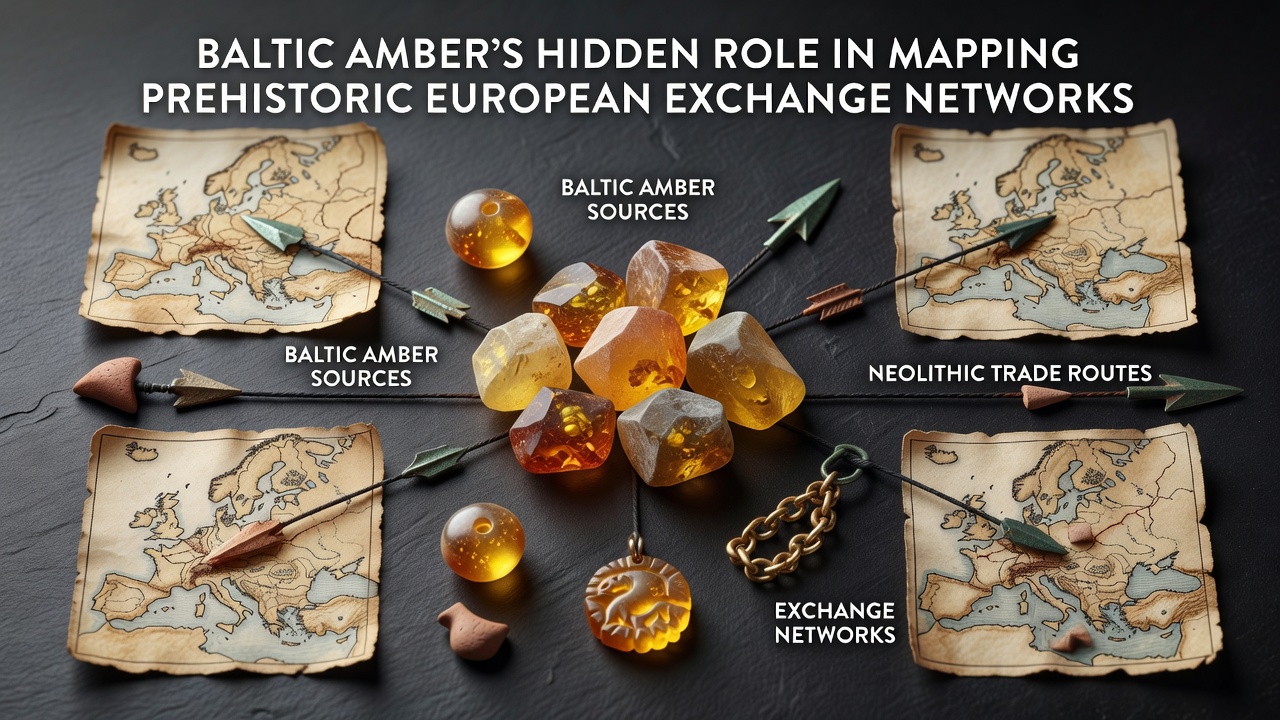
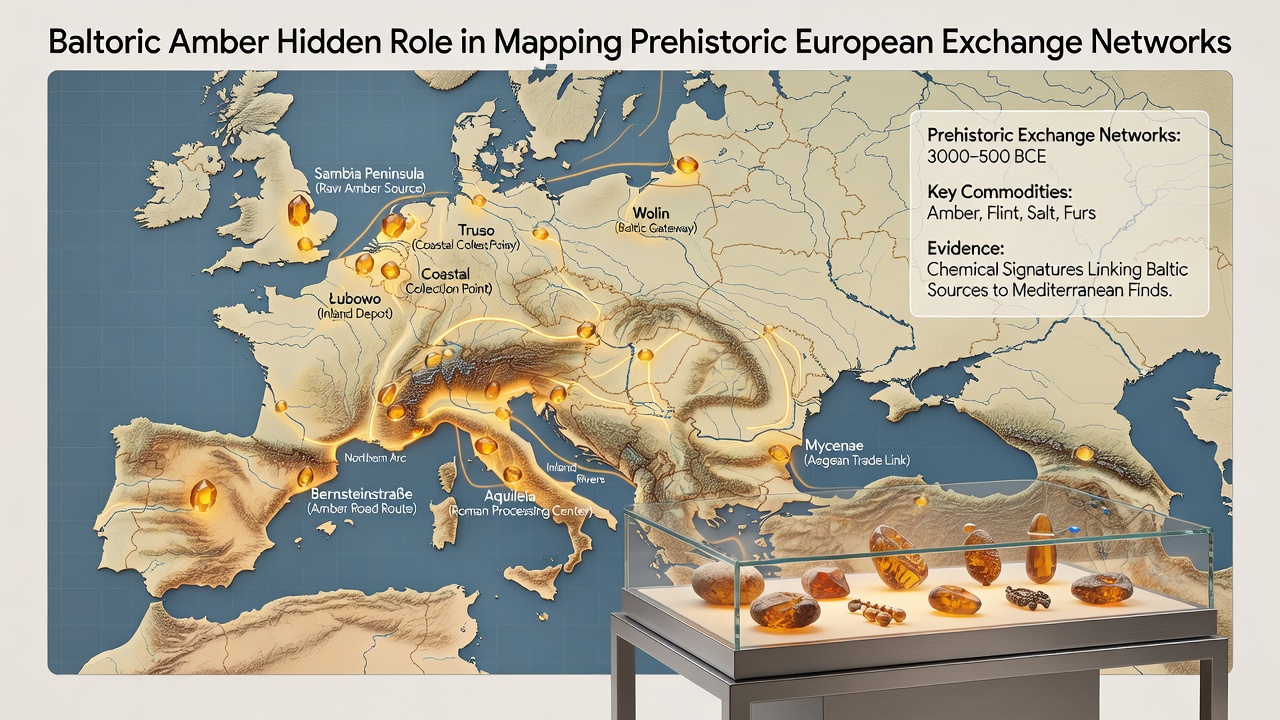
Baltic amber has long served as more than decorative material for prehistoric communities across Europe because its chemical signature allows researchers to trace movement between distant regions. Deposits formed millions of years ago in the area now known as the Baltic Sea basin contain distinctive markers such as high succinic acid content that differentiate them from other European resins, and this property has helped archaeologists reconstruct exchange systems that operated thousands of years before written records. Trade networks carried raw amber and finished beads from northern coasts southward to the Mediterranean and eastward toward the Black Sea, connecting groups that otherwise left few clues about their interactions.
Early Discoveries and Pattern Recognition
Archaeologists began noting amber finds at Mycenaean sites in Greece during the nineteenth century, and subsequent excavations revealed concentrations at locations hundreds of kilometers from any natural source. Researchers catalogued beads, pendants, and raw lumps at burial contexts dating to the Bronze Age, while similar items appeared in central European hoards and Italian settlements. One study revealed that the distribution aligned with known river corridors and coastal routes, suggesting organized movement rather than random drift. Observers note that the sheer volume at certain nodes implies repeated journeys rather than single events, and this pattern has prompted closer examination of associated goods such as metals and ceramics that traveled alongside the resin.
Chemical Tracing Methods and Their Contributions
Scientists apply infrared spectroscopy and gas chromatography to confirm Baltic origin without relying on visual inspection alone, and these techniques have refined earlier maps of prehistoric pathways. Data indicates that amber reached the Iberian Peninsula by the third millennium BCE, while finds in the Carpathian region point to overland routes crossing modern Poland and Slovakia. What's interesting is how small quantities discovered at peripheral sites still match the Baltic profile, showing that even remote communities participated in broader circuits. Researchers discovered clusters near the Danube that coincide with copper and tin movements, illustrating how amber formed one element within multi-commodity exchanges.
Regional Case Examples
Take one researcher who examined a collection from the Wessex region in Britain and found that several beads matched Baltic spectra despite the distance involved. Similar results emerged from Swiss lake dwellings where amber accompanied jadeite axes sourced from the Alps. People who've studied these assemblages often discover that amber appears in both elite graves and more modest contexts, indicating varied social access across different periods. But here's the thing: not every site shows the same intensity of contact, and some areas received only finished objects while others handled raw material for local working.
Evidence suggests the networks intensified during the Bronze Age when demand for exotic materials grew alongside emerging hierarchies. Figures from the European Association of Archaeologists reveal ongoing projects that combine amber data with strontium isotope analysis of human remains to track individual mobility. And yet the picture remains incomplete because many finds come from disturbed contexts or antiquarian collections lacking precise provenience. Those who've studied this know that future fieldwork in the Baltic source areas themselves may clarify extraction methods and seasonal timing of collection.
Upcoming Research Developments
Preparations are underway for an international symposium scheduled in Gdańsk during October 2026 that will bring together specialists working on northern and southern European assemblages. The meeting is expected to present updated distribution maps based on recently excavated material from the eastern Baltic and new analyses from Balkan sites. Observers note that such gatherings allow comparison of datasets collected under different national standards, and they often lead to collaborative sampling programs that extend the known range of Baltic amber circulation.
Connections Beyond Europe
Although the primary focus remains intra-European movement, some amber pieces have turned up in contexts that hint at longer-distance contacts reaching into the Near East during the Late Bronze Age. According to findings reported by the Archaeological Institute of America, a small number of beads recovered from Egyptian tombs carry the Baltic chemical signature, raising questions about intermediaries along the eastern Mediterranean. Yet these outliers represent exceptions rather than the rule, and most documented transfers stayed within the European continent. The reality is that amber functioned as both a prestige item and a practical marker that modern science can follow backward through time.
Conclusion
Baltic amber continues to illuminate prehistoric exchange networks because its unique properties survive in the archaeological record while many organic goods do not. Ongoing analyses refine the routes, timing, and participants involved in these ancient systems, and the October 2026 symposium will likely add further detail to existing models. Researchers rely on cumulative evidence from multiple sites and methods to build a clearer picture of how communities interacted across vast distances long before modern borders existed.